
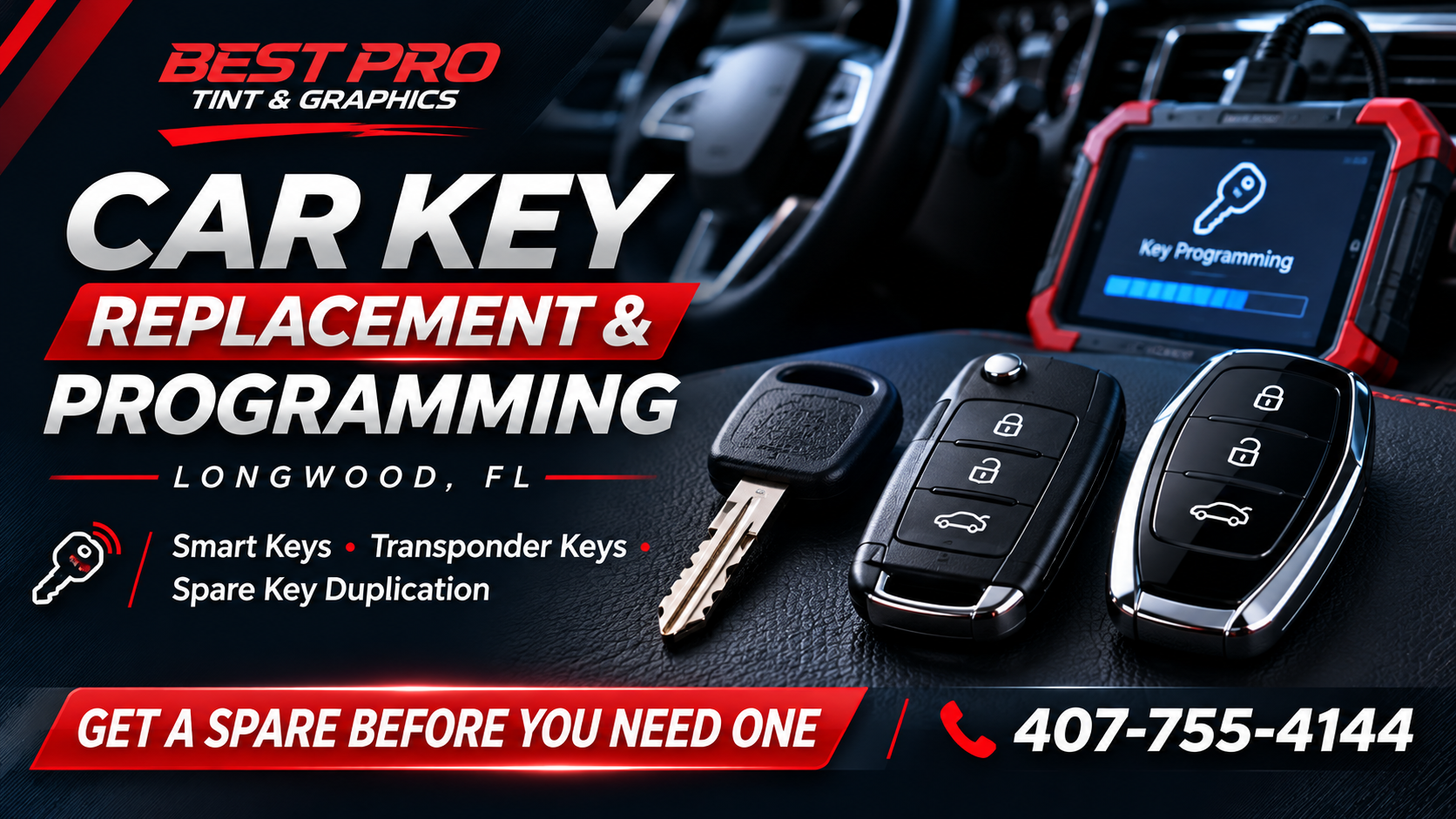
Car Key Programming Explained: How Transponder Keys, Smart Keys & Replacement Actually Work
Understand the technology behind modern vehicle keys, why replacement keys sometimes fail, and what to know before requesting a spare or replacement in Longwood, Florida.
Imagine walking outside, getting into your vehicle, and discovering that your car key no longer starts the engine. The remote may unlock the doors, but the engine will not start. Perhaps you purchased a replacement key online, but the vehicle refuses to recognize it. Or maybe you have only one working key and want to make a spare before something happens to it.
Modern automotive keys are no longer simply pieces of metal cut to match a lock. Many vehicles use electronic security systems that communicate with a transponder chip, remote transmitter, immobilizer, or proximity-based smart key.
Understanding how these systems work can help you avoid purchasing the wrong replacement key, identify the cause of a malfunction, and understand why some vehicles require specialized programming equipment.
1Why Modern Car Keys Have Electronic Security Systems
Older vehicles generally used mechanical keys. If the key was cut correctly, its physical shape allowed it to operate the ignition cylinder and door locks.
Manufacturers introduced electronic immobilizer systems to make unauthorized vehicle starting more difficult. An immobilizer is an electronic security system that prevents the engine from starting unless the vehicle recognizes an authorized key.
A modern vehicle may require two separate things before it can be operated:
- A correctly cut physical key, when the vehicle uses a mechanical ignition or lock.
- An electronically authorized key that the vehicle’s security system recognizes.
These functions work together, but they are not the same. A key can be physically cut correctly and still fail to start the vehicle because its electronic chip has not been authorized. Likewise, a vehicle may recognize the electronic chip but still have a problem with a damaged or incorrectly cut mechanical blade.
This distinction is important when ordering replacement keys.
2What Is a Transponder Key and How Does It Work?
A transponder key contains a small electronic chip, usually embedded inside the plastic head of the key or within its electronic housing. The word transponder refers to a device that responds to a signal from another electronic system.
What happens when you use a typical transponder key?
Step 1 · Key insertion
The key is inserted into the ignition. When you turn it, the vehicle’s immobilizer system attempts to identify the transponder.
Step 2 · Chip communication
An antenna or reader around the ignition area generates a signal that allows the transponder to communicate with the vehicle.
Step 3 · Authorization check
The immobilizer evaluates the response against the keys authorized for that vehicle.
Step 4 · Start permission
If the key is recognized, the immobilizer allows the appropriate engine-start functions to proceed. If not, the vehicle may prevent engine operation.
Many traditional transponder systems can receive the energy needed to respond from the reader itself, so the chip does not necessarily require its own battery.
Why cutting a transponder key is not enough
A replacement transponder key has two separate requirements:
- The metal blade must be cut to match the vehicle’s mechanical lock or ignition, if applicable.
- The electronic transponder must be compatible and authorized by the vehicle’s immobilizer system.
This is why a key-cutting machine may duplicate the physical shape without completing the electronic portion of the job. A properly functioning replacement requires both parts to be addressed when the vehicle uses both systems.
3What Is the Difference Between a Transponder Key and a Remote Key Fob?
These terms are often confused because many modern keys combine multiple technologies in one housing. A transponder is primarily associated with the vehicle’s electronic starting authorization. A remote key fob sends commands to the vehicle, such as locking and unlocking the doors. Some keys contain both functions.
| Component | Main purpose | What it may control |
|---|---|---|
| Mechanical blade | Physical access | Door lock or ignition cylinder, where fitted |
| Transponder chip | Engine-start authorization | Immobilizer recognition |
| Remote transmitter | Remote convenience functions | Lock, unlock, trunk release and other buttons |
| Smart-key electronics | Proximity-based access and authorization | Keyless entry and push-button starting, depending on vehicle |
This explains an important situation: your remote buttons can stop working even when the vehicle still starts. A weak fob battery, damaged remote transmitter, or lost remote synchronization may affect the buttons without necessarily affecting the immobilizer chip.
Similarly, a key may unlock the doors mechanically but fail to authorize the engine to start. The correct diagnosis depends on which function is failing.
4How Do Smart Keys and Push-Button Start Systems Work?
Smart keys, also called proximity keys, let drivers access and operate their vehicles without inserting a conventional key into the ignition. These systems are common in newer vehicles from many manufacturers.
How proximity detection works
- Approach: Depending on the vehicle, antennas positioned around the doors or cabin detect a nearby authorized key.
- Communication: The vehicle sends a request, and the key responds using its electronic identification and security protocol.
- Verification: The security system determines whether the key is recognized and whether the required conditions are satisfied.
- Authorization: When the key is authorized and the vehicle’s other operating conditions are met, the driver can unlock the vehicle or use push-button start.
The exact communication method and security protocol differ among manufacturers and vehicle generations.
Why smart keys are more complicated to replace
A smart key is not simply a remote with a different appearance. It may contain proximity communication electronics, vehicle-specific identification, remote locking functions, push-button start authorization, an emergency mechanical blade, and a battery that powers normal remote and proximity functions.
Replacement requires a compatible fob and the appropriate registration procedure for the vehicle. Some manufacturers also use security credentials or additional authorization procedures that make programming more involved.
This is why two smart keys that look identical may not be interchangeable.
5What Actually Happens During Car Key Programming?
Car key programming is the process of registering or authorizing a compatible electronic key with the vehicle’s security system. The process varies according to the manufacturer, year, model, and immobilizer generation.
A typical professional programming workflow
- Vehicle and key identification: The technician identifies the vehicle’s year, make, model, and applicable key system. The replacement must match the vehicle’s requirements, including the correct electronic configuration and, where applicable, frequency and transponder type.
- Physical key cutting, when required: If the replacement uses a mechanical blade, the blade must be cut to the appropriate key pattern. Some vehicles use an emergency blade inside a smart-key fob, while others have no conventional ignition blade.
- Connecting diagnostic equipment: Many modern vehicles require specialized automotive diagnostic equipment to access immobilizer or key-registration functions. Depending on the vehicle, communication may take place through the diagnostic connector or another manufacturer-specific interface.
- Key registration: The technician follows the applicable procedure to register the new key. Some vehicles support adding a key while existing keys remain authorized; others require a more involved all-keys-lost procedure.
- Function testing: The replacement key should be tested for the functions it is designed to perform, such as engine-start authorization, locking and unlocking, trunk release, proximity detection, push-button starting, and emergency blade operation.
Not every vehicle uses the same procedure, and some require additional security credentials or manufacturer-specific access. A successful programming message should not replace testing the actual key functions.
6Adding a Spare Key vs. Replacing All Lost Keys: Why the Difference Matters
There are two very different situations in automotive key service.
Situation A · One working key remains
This is generally an additional-key or add-key situation. The vehicle already has a recognized key, and the objective is to add another compatible key. Depending on the vehicle, this may be a relatively straightforward process, although some vehicles still require specialized procedures.
Situation B · All keys are lost
The vehicle has no available working key to authorize normal starting. Replacement may require additional security access, vehicle-specific credentials, or a more involved immobilizer procedure. Some vehicles require dealer-level support or equipment not available for every independent service provider.
Why having a spare key is a smart decision
Consider a customer who owns a vehicle with only one smart key. If that key is lost, the customer may need a more complicated replacement process and may have to arrange transportation for the vehicle.
By arranging a spare while the original key still works, the customer may avoid some of those complications. The exact cost difference depends on the vehicle, but having a second authorized key provides an important backup.
7Why Does My Car Key Stop Working?
Not every key problem requires a complete replacement. Before purchasing another key, it is important to understand the symptoms.
Problem 1 · Remote buttons do not work, but the vehicle starts
Possible causes include a weak or depleted fob battery, damaged remote-control buttons, internal circuit-board damage, or remote synchronization problems. If the vehicle still recognizes the transponder or smart-key authorization, the immobilizer portion may be functioning correctly.
Problem 2 · The key unlocks the doors but will not start the engine
Possible causes include an unrecognized transponder, a damaged chip, an immobilizer system problem, a vehicle battery or electrical issue, or a key that is not properly authorized. A security warning or immobilizer indicator may provide additional diagnostic information.
Problem 3 · The vehicle displays “Key Not Detected”
This message is commonly associated with proximity or smart-key systems. Possible causes include a weak smart-key battery, a key outside the detection range, radio-frequency interference, a damaged fob, a vehicle antenna or receiver issue, or a key that has not been registered correctly.
Many vehicles include an emergency starting procedure that allows the fob to be placed near a designated backup reader or start-button location. Check the owner’s manual for the correct procedure for your vehicle.
Problem 4 · The key works intermittently
Intermittent operation can be caused by a weak battery, worn buttons, damaged electronics, poor connections, or vehicle-side communication problems. Replacing the key immediately may not solve the problem if the actual fault is in the vehicle.
Problem 5 · The physical key will not turn
If a mechanical key will not turn in the ignition or door lock, possible causes include incorrect key cutting, a worn key blade, a damaged lock cylinder, or a mechanical problem within the ignition or door lock. Electronic programming will not correct an incorrectly cut blade or a damaged mechanical lock.
8Can You Buy a Replacement Car Key Online?
Yes, replacement keys are available online, but buying the correct one requires more than matching the picture. Two keys may have the same shape and button arrangement while using different electronic components.
Before purchasing, compatibility should be checked using:
- Vehicle year, make, and model.
- Original key part number, when available.
- Transponder or smart-key system.
- Radio frequency and electronic configuration, where applicable.
- Manufacturer compatibility information.
What does an unprogrammed or aftermarket key mean?
Some replacement keys are sold without vehicle-specific programming. An aftermarket key may be designed to function as a replacement for certain original-equipment keys, but quality and compatibility vary.
A key that is not compatible with the vehicle cannot necessarily be made compatible through programming. Also, some previously used electronic keys may be locked or otherwise unsuitable for registration to another vehicle.
Before ordering a replacement, confirm that the key can be programmed to your particular vehicle using the intended procedure.
9What Information Should You Provide When Requesting Car Key Service?
Providing accurate vehicle information helps identify the correct replacement and determine whether the service is supported.
- Vehicle year: For example, 2021.
- Vehicle make: Toyota, Honda, Nissan, Ford, BMW, Mercedes-Benz, and so on.
- Vehicle model: Camry, Accord, Altima, F-150, X5, Tucson, etc.
- Key type: Traditional key, transponder key, remote-head key, flip key, or smart key, if known.
- Current key situation: Two working keys, one working key and need a spare, damaged key, remote buttons not working, or all keys lost.
- Vehicle availability: Whether the vehicle is available for service and whether it is currently operational.
A photograph of your existing key can also help with initial identification. For security reasons, be prepared to provide identification and proof that you are authorized to request service for the vehicle. Do not send sensitive vehicle information through public comments or social media posts.
10Why Professional Key Identification and Programming Matter
Modern vehicle security systems are designed to prevent unauthorized access and starting. Using the wrong replacement key or attempting an incompatible programming procedure can waste money and create additional problems.
A proper assessment should establish:
- Which key system the vehicle uses.
- Which replacement key is compatible.
- Whether the physical blade needs cutting.
- Whether electronic programming is required.
- Whether the vehicle is supported by the available equipment.
- Which functions must be tested after programming.
At Best Pro Tint & Graphics, we offer automotive key duplication and programming services for supported vehicles. We help customers identify their key requirements and determine the appropriate service before proceeding.
Vehicle coverage is not universal. Some advanced systems require manufacturer-specific procedures or equipment outside our current service capabilities. We recommend confirming compatibility before scheduling or purchasing a replacement key.
Frequently Asked Questions About Car Key Programming
Does every modern car key contain a transponder chip?
No. Key technology varies by vehicle. Some use mechanical keys, some use transponder systems, and others use proximity-based smart keys. Some keys combine several technologies.
Can a transponder key be duplicated?
Many transponder keys can be duplicated or programmed when the correct compatible key and supported programming procedure are available.
Does replacing a key-fob battery erase the programming?
In many vehicle systems, replacing the fob battery does not erase the immobilizer authorization. However, remote synchronization or other procedures may be required in certain cases.
Why does my car recognize the key but the remote buttons do not work?
The immobilizer and remote-control functions may operate separately. A depleted battery, damaged transmitter, or remote synchronization issue may affect the buttons without affecting engine-start authorization.
Can I program a car key myself?
Some vehicles support owner-performed spare-key procedures under specific conditions. Many modern vehicles require specialized equipment, security credentials, or manufacturer-specific procedures. Always consult the owner’s manual and use an authorized procedure.
Is an aftermarket smart key just as good as an original key?
Not automatically. Quality and compatibility vary. The key must have the correct electronic configuration and must support the vehicle’s required functions.
Can a replacement key be made if all keys are lost?
Some vehicles support all-keys-lost replacement procedures, but availability depends on the security system, programming equipment, and required authorization. Compatibility should be checked before making an appointment.
How much does car key programming cost?
Pricing depends on the vehicle, key type, replacement part, programming procedure, and whether an existing working key is available. Contact us with your vehicle information for an accurate assessment.
Need a Spare or Replacement Car Key?
Do not wait until your only working key disappears. Whether you need a spare transponder key, an additional remote, a smart-key replacement, or an assessment for a vehicle with no working keys, the first step is identifying the correct key system.
Contact Best Pro Tint & Graphics to check vehicle compatibility and discuss your car key programming services.
Call or Text 407-755-4144 Request a QuoteBest Pro Tint & Graphics
740 W State Road 434, Longwood, FL 32750
Serving Longwood, Lake Mary, Sanford, Altamonte Springs, Winter Springs, and the greater Orlando area.
Vehicle compatibility must be confirmed before scheduling. Some advanced systems require manufacturer-specific procedures or equipment outside our current service capabilities.