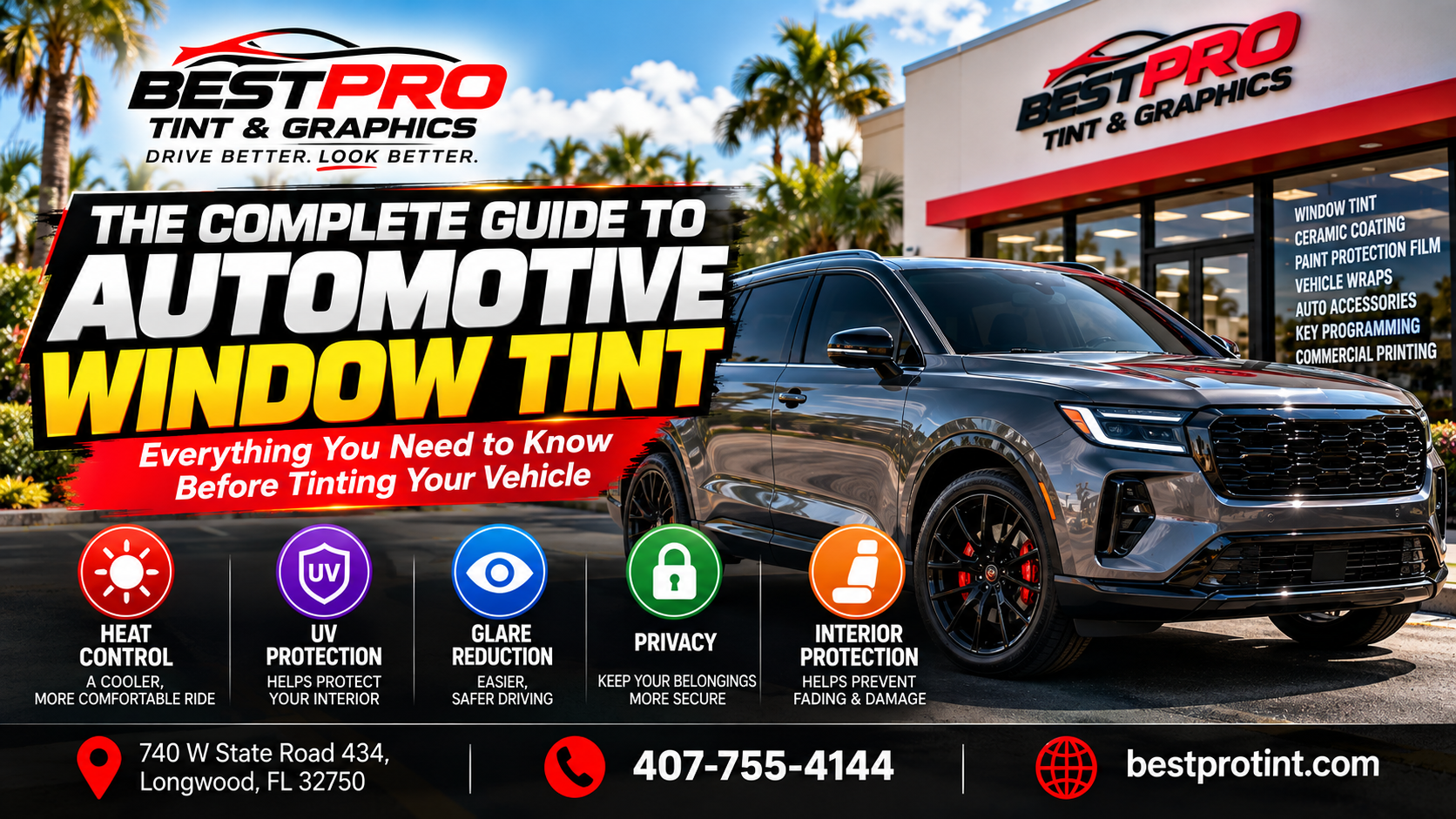
If you’re thinking about tinting your vehicle, you have probably discovered that choosing window tint is not as simple as picking a percentage and booking an appointment. Questions pile up quickly: how dark should the windows be, is ceramic really worth the extra money, does factory privacy glass already count as tint, and what does Florida law actually allow?
Then there is the vocabulary. Installers talk about VLT, infrared rejection, TSER, UV protection, ceramic, carbon and dyed film, and it can be hard to tell which specifications matter and which are mostly marketing. The good news is that none of this has to be complicated once the basic ideas are laid out in order.
This guide walks through everything you should understand before tinting, so you can make a decision based on your vehicle, your driving habits, the look you want, your budget and Florida’s requirements. Whether you drive a sedan, SUV, truck, luxury vehicle or daily commuter, the right film can do much more than darken the glass. Properly selected and professionally installed, it can improve comfort, cut glare, block UV, add privacy and help protect your interior from Central Florida sun.
What Is Automotive Window Tint, and How Does It Work?
Automotive window tint is a thin, multi-layer film applied to the inside surface of a vehicle’s glass. Depending on how it is built, the film can control visible light, ultraviolet radiation and part of the infrared energy that carries heat, all while changing how the glass looks. Some films are designed mainly for appearance and privacy, while higher-performance films are engineered for serious solar control.
When sunlight hits your car, part of that energy passes through the glass, part is reflected and part is absorbed. A good film manages specific slices of that solar spectrum rather than simply blocking light across the board. That is why a fairly light-looking window can still deliver meaningful heat and UV performance, and why the darkest film on the wall is not automatically the coolest one.
For Florida drivers this distinction matters a great deal. The goal is to choose film for the combination of appearance and performance you actually want, not for darkness alone. The International Window Film Association (IWFA), the industry’s nonprofit trade group, lists UV protection, heat control and glare reduction among the main benefits of automotive film, while reminding drivers that darkness limits are set state by state.
Factory Privacy Glass vs. Aftermarket Window Film
One of the first things to understand is that factory glass and aftermarket tint are two different things. Factory glass is installed by the vehicle manufacturer, and on many SUVs, trucks, crossovers and minivans the rear doors, rear quarter windows and back glass come darker from the factory. Aftermarket film is installed later, on top of whatever glass the vehicle already has.
Factory privacy glass gets its darker look from pigment added to the glass itself during manufacturing. Because the color is in the glass rather than applied over it, it behaves differently from film, and a dark appearance tells you very little about how much solar energy the glass actually rejects. A vehicle can have very dark rear glass and still benefit noticeably from a film designed for heat control.
Florida law treats the two differently as well. Manufacturer tinting that complies with Federal Motor Vehicle Safety Standard No. 205 is exempt from the state’s window-tint provisions under Section 316.2957, Florida Statutes. Once aftermarket film is added, however, the window is measured as glass and film together, which is why factory glass matters so much when choosing a film percentage.
This leads to a question we hear constantly: “My vehicle already has dark windows, so do I really need tint?” If you are happy with the current look and comfort, maybe not. If you want more heat control, glare reduction, UV protection, privacy or front windows that match the rear, aftermarket film can still add real value. For a deeper look, see our companion article, Factory Privacy Glass vs. Window Tint: What’s the Difference?
What Does VLT Mean?
VLT stands for Visible Light Transmission, the percentage of visible light that passes through the glass. The rule of thumb is simple: a higher VLT means a lighter window and a lower VLT means a darker one. A 50% film lets roughly half the visible light through, while a 20% film lets through about a fifth.
There is one detail many customers miss. The percentage printed on a film roll or sample card describes the film by itself, not the finished window on your car. Because the film goes over existing glass, and that glass already blocks some light, the final reading is the combination of the two and is always darker than the film’s label. That is why a professional installer evaluates your actual vehicle instead of simply saying, “We’ll put 20% on it.”
Understanding Common Tint Percentages
The five percentages below are the ones customers ask about most. Keep in mind that these describe the film’s nominal rating, and the finished window will measure darker once it is combined with your glass.
| Film rating | Look | What to know |
|---|---|---|
| 5% (“limo”) | Extremely dark | Maximum privacy, but darker than Florida’s minimum for any window; it also sharply reduces night visibility. |
| 15% | Very dark | Strong privacy; often requested for rear glass, but the combined reading must still meet Florida’s limit. |
| 20% | Dark | A popular middle ground with clear privacy and better visibility than 5% or 15%. |
| 35% | Moderate | A subtle, factory-style look that still cuts glare and adds some privacy. |
| 50% | Light | Chosen mainly for heat and UV performance without changing the vehicle’s appearance much. |
Does Darker Tint Mean More Heat Rejection?
Not necessarily, and this is one of the biggest misconceptions in the industry. Darker film lets less visible light through, but visible light is only part of the solar energy that heats a car. A well-engineered lighter film can outperform a cheaper, darker one, which is exactly what ceramic films are designed to do. So when you compare films, ask “How does it perform?” as well as “How dark is it?”
Infrared Rejection
Infrared (IR) energy is the part of sunlight you feel as heat on your skin, so manufacturers like to advertise high IR rejection numbers. Those numbers are useful, but they are not the whole story. Brands measure IR over different wavelength ranges and under different test conditions, so a bigger number on one brochure is not automatically better than a smaller number on another.
Total Solar Energy Rejected (TSER)
TSER is the single best number for comparing overall heat performance. It combines visible light, infrared and ultraviolet energy into one figure for the total share of solar energy the film keeps out. When two films look similar, comparing their TSER, measured on the same type of glass, will usually tell you more than comparing IR alone.
UV Protection
Quality automotive films block the vast majority of ultraviolet radiation, and the IWFA highlights this as one of film’s most important benefits for skin and eyes. UV is also a leading cause of fading and cracking in dashboards, leather and trim. Film cannot stop every kind of interior aging, but it removes one of the biggest contributors.
More Benefits of Window Tint
Glare Reduction
Anyone who drives in Florida knows how tiring direct sun can be, especially early in the morning and late in the afternoon. Glare makes the road harder to read and washes out navigation and infotainment screens. By reducing the visible light entering the cabin, film makes the driving environment easier on your eyes, and the right VLT depends on your preferences, your vehicle and the law.
Privacy and Security
Darker glass makes it harder for people outside to see you, your passengers and anything left on the seat. That privacy comes with a trade-off, though, because the darker the glass, the less light you have to see out, particularly at night. A good installation balances privacy and appearance with the visibility you actually need behind the wheel.
Interior Protection
Your seats, dashboard and door panels are exposed to sun every time the car is parked outside. Over time, UV and heat cause fading, discoloration and drying of interior materials. Tint is one part of a broader protection strategy that also includes covered parking, a sunshade and regular interior care, and for a vehicle that lives outdoors in Central Florida it is well worth considering.
Dyed vs. Carbon vs. Ceramic Window Film
Not all tint is made the same way. The three categories you will hear about most are dyed, carbon and ceramic, and at Best Pro Tint & Graphics they correspond to our Standard, Carbon and Ceramic IR options.
Dyed Film (Our Standard Option)
Dyed film is the traditional, most economical choice. It uses dye layers to darken the glass and reduce glare, which makes it a good fit if your main goals are appearance and basic privacy. Its trade-off is that it rejects less heat than the other categories, and older or lower-grade dyed films can fade or turn purple as they age.
Carbon Film
Carbon film uses carbon particles in its construction, giving it a deep, matte-black look that resists fading. It rejects more heat than dyed film and is a solid middle ground for drivers who want a darker appearance with better performance, without paying for top-tier ceramic.
Ceramic and Ceramic IR Film
Ceramic film uses non-metallic ceramic particles to block heat without relying on extreme darkness. That lets you choose a lighter, cleaner look and still get strong solar performance, with no interference to phone, GPS or radio signals. Ceramic IR is a ceramic film engineered with extra emphasis on infrared rejection. For Florida drivers who put cabin comfort first, it is usually the film to consider, but compare full specification sheets and TSER values rather than a single advertised IR number.
| Dyed (Standard) | Carbon | Ceramic IR | |
|---|---|---|---|
| Best for | Appearance and value | Darker look plus better performance | Maximum comfort and heat control |
| Heat rejection | Basic | Good | Highest |
| Fade resistance | Lower | High | High |
| Price | $ | $$ | $$$ |
How to Choose the Right Film and Darkness
There is no single best film for every driver, so start with what matters most to you. Do you want a cooler cabin, more privacy, a darker look, UV protection, less glare, a factory-style appearance, maximum performance or the best price? Someone who mostly wants a cosmetic upgrade may not need premium ceramic, while someone who spends hours a day driving in Florida sun will usually get real value from it.
Darkness deserves the same thought. If you drive a lot at night, a lighter film on the front windows will be easier to live with. If rear privacy is the priority, darker rear glass may make sense where the law allows it, and if you want a factory look, a moderate VLT is usually the answer. A professional installer should walk you through these trade-offs on your specific vehicle.
SUVs
SUVs are among the most commonly tinted vehicles, and most already have factory privacy glass in the back with much lighter front windows. The most common request is to make the front match the rear, which can often be done visually as long as the film is chosen around the actual glass and Florida’s front-window limit. Large SUVs, especially those with panoramic roofs, have a lot of glass, which is why ceramic film is so popular with SUV owners.
Trucks
Pickups usually have factory privacy glass behind the driver and lighter front windows, so owners often want the fronts to blend in without losing practical visibility. Trucks also spend a lot of time parked in the open, and their cabins can get extremely hot. A quality film helps with comfort while tying the truck’s appearance together.
Sedans
Sedans have less glass than large SUVs, but tint still makes a noticeable difference in comfort and appearance. Sedan owners commonly tint for privacy, glare reduction, UV protection and heat control. Most sedans do not have factory privacy glass, and Florida applies a different rear-window limit to sedans than to SUVs and trucks, so the percentage should be chosen for the specific car.
Luxury Vehicles
High-end vehicles often have premium leather, sensitive electronics and sophisticated interior materials, so owners tend to put extra weight on comfort and interior preservation. Ceramic film suits these vehicles well because it delivers performance with a refined, clean look. The installation matters just as much, with careful prep and attention to the interior, trim and electronics.
Florida Window Tint Laws: What Drivers Need to Know
Florida regulates aftermarket tint by window location, and in some cases by vehicle type. The limits apply to the finished window as tested on your vehicle, meaning the glass and film together, not the number on the film’s label. Florida law defines transmittance to include the glazing itself, so the factory glass always counts toward the reading.
| Window | Minimum VLT (glass + film) | Maximum reflectance | Statute |
|---|---|---|---|
| Windshield | Transparent strip only, above the AS-1 line | — | s. 316.2952 |
| Front side windows | 28% | 25% | s. 316.2953 |
| Rear side and back windows, sedans and other cars | 15% | 35% | s. 316.2954 |
| Rear side and back windows, SUVs, vans and trucks (multipurpose passenger vehicles) | 6% | 35% | s. 316.2954 |
The front side windows include the side windows and side wings next to or forward of the driver’s seat. A “multipurpose passenger vehicle” is one designed to carry 10 or fewer people and built on a truck chassis or with special features for occasional off-road use, as defined in s. 316.2951. Most SUVs, pickups and many vans fall into this group, but sedans and coupes do not, so the same 15% film can be legal on one vehicle’s rear glass and not on another’s.
There is one more rear-window rule that often gets overlooked. If the back window is tinted dark enough to be non-transparent, the vehicle must have outside mirrors on both sides, under s. 316.2954(2).
Windshield Tint
Florida generally prohibits tint on the windshield. The only exception is a transparent strip along the top that stays above the AS-1 line, the marking that federal standards use to define the edge of the driver’s direct forward view. A windshield film being “light” does not by itself make it legal, and windshield work also involves practical risks around the cameras and sensors many modern vehicles mount near the glass.
Labels, Tolerance and Medical Exemptions
Under s. 316.2955, the installer must place a compliance label on the inside of the driver’s door jamb stating the film’s trade name and the installer’s business name. The same section gives every percentage measurement a tolerance of plus or minus 3 percent. Factory glazing that meets federal standards does not need a label.
Florida also offers a medical exemption for people with lupus, autoimmune diseases or other conditions that require limited light exposure. Under s. 316.29545, the Department of Highway Safety and Motor Vehicles issues a certificate tied to a specific vehicle, listing its make, model, year and VIN. The certificate cannot be transferred and becomes void if the vehicle is sold.
Penalties
Driving a vehicle with non-compliant tint is a noncriminal, nonmoving traffic infraction. Selling or installing non-compliant tint is more serious: it is a second-degree misdemeanor under s. 316.2956, which is one reason reputable shops measure carefully and will turn down requests that would break the law.
Florida statutes can change. This section reflects the 2026 Florida Statutes and is educational information, not legal advice, so confirm the current requirements for your vehicle before installation.
What If You Already Have Old Tint?
If your current film is bubbling, peeling, discolored or damaged, putting new film over it is not the fix. The old film needs to come off first, and removal can take real time because adhesive residue often stays on the glass. Rear windows need extra care, since aggressive scraping can damage the defroster lines, so old-film removal is a job best left to a professional.
Common Window Tint Problems
Bubbling
Small water pockets can appear right after installation while the film cures, and on their own they are not a sign of failure. Large pockets, bubbles that don’t shrink, or bubbling that shows up months or years later usually point to an adhesive or installation problem. When the bubbles appear and what they look like both matter.
Peeling
Peeling edges happen when the adhesive fails or the original installation was compromised. Once an edge lifts, dirt and moisture work their way underneath and the problem spreads. In most cases the affected film has to be removed and replaced.
Purple or Discolored Film
Older dyed films can change color as they break down in the sun. If your tint has gone from a clean neutral shade to purple, blue or another odd tint, it has reached the end of its life and should be replaced.
Haze
Haze or visual distortion can come from film deterioration, installation problems, adhesive issues or contamination trapped under the film. A little haze is normal during curing, but haze that lasts deserves a professional inspection to decide whether it is normal, repairable or a reason to replace the film.
What Happens During a Professional Installation?
A professional installation is much more than sticking film onto glass. The vehicle is protected, the glass is deep-cleaned, and the film is cut and shaped to each window, often using computer-cut patterns for a precise fit. It is then applied while controlling dust and moisture, squeegeed into place and checked along every edge. Even the best film will look poor if this part is rushed.
Installation time depends on the vehicle and the scope of the job. Two front windows can be done fairly quickly, while a full sedan, SUV or truck can take several hours, and old-film removal or complex curved glass adds more. At Best Pro Tint & Graphics, we schedule appointment time around your specific vehicle and service instead of treating every car as the same job.
The Curing Process
Fresh film holds a small amount of moisture from installation, and that moisture gradually evaporates as the film cures. During that period you may see small water pockets or a slightly hazy look, which is normal and usually clears on its own. Curing time varies with the film, the glass, temperature and humidity, and Florida’s heat and humidity can speed it up or slow it down. If something looks wrong, call your installer before you press, poke or peel anything.
As for rolling the windows down, follow the specific timeframe your installer gives you. The film needs time to bond to the glass, and lowering a window too early can catch and lift the top edge.
How to Care for New Window Tint
Leave the film alone during the curing period, and avoid cleaning or pressing on the inside of the glass. Once it has cured, clean it with a soft microfiber cloth and an ammonia-free, tint-safe cleaner. Skip paper towels, abrasive pads and anything with grit, and take extra care around the film edges, which also applies when film has been installed over factory privacy glass.
How Much Does Automotive Window Tint Cost?
There is no single price for window tint, because cost depends on several factors working together. The biggest ones are:
- Vehicle size: A compact sedan takes less film and labor than a full-size SUV or truck.
- Number of windows: Two front windows is a very different job from a full vehicle.
- Film type: Dyed, carbon and ceramic films differ in materials and performance.
- Existing tint: Old film may need to be removed before new film goes on.
- Window complexity: Curved or unusually shaped glass takes more preparation.
- Windshield or specialty glass: These involve different legal and technical considerations.
- Installation quality: Experienced, careful installation is part of what you pay for.
When comparing quotes, make sure they cover the same windows and a comparable film. A $200 quote and a $500 quote may not be offering anything close to the same product, and the cheapest ceramic quote is not the best value if the film, warranty or workmanship is weaker. The most accurate price comes from looking at the vehicle and talking through the film you want.
Cheap Tint vs. Professional Installation
A low price is tempting, but the cheapest tint job is not always the least expensive over the life of your vehicle. Low-grade film can fade or fail sooner, and poor workmanship shows up as trapped particles, uneven edges, bubbles, distortion or peeling. Removing failed film and tinting again means paying twice, so it pays to compare more than the price tag.
How Long Does Window Tint Last?
Lifespan depends on the film, the installation, sun exposure and how the windows are cared for. High-quality film that is installed correctly can last many years, while lower-grade film may start to deteriorate much sooner. Warning signs include bubbling, peeling, purple or odd discoloration, haze, scratches and failing adhesive, and if you see them an inspection will tell you whether the film needs repair, removal or replacement.
Questions to Ask a Window Tint Installer
Before you book, it is worth asking a few questions so you know exactly what you are getting:
- What film are you installing? Don’t settle for “ceramic.” Ask for the brand and product line.
- What are its performance specs? Ask for the manufacturer’s published VLT, TSER and UV figures.
- What will my windows measure when finished? The film’s label and the glass-plus-film result are different numbers.
- Does my vehicle already have factory privacy glass? It changes the final look and reading.
- Is what I want legal in Florida for my vehicle? The answer depends on the window and the vehicle type.
- What warranty is included? Know what is covered and for how long.
- Who will do the installation? Experience matters.
- Do you remove old tint, and how? This matters most on rear glass with defroster lines.
- How long should I wait before cleaning or rolling down the windows? A good installer will explain curing clearly.
- What happens if I have a problem later? A professional shop should have a clear process for follow-up.
Automotive Window Tint FAQ
Is window tint worth it in Florida?
For most Florida drivers, yes. Tint adds privacy, cuts glare, blocks UV and helps control heat, and the value you get depends on your vehicle, the film you choose and what you care about most.
Is ceramic tint better than regular tint?
Ceramic is a higher-performance category, especially for heat control at lighter shades. Whether it is “better” for you depends on your goals, but if a cooler cabin is a top priority it is usually worth the upgrade.
Does darker tint reject more heat?
Not necessarily. Darkness measures visible light, while heat rejection depends on how the film handles infrared and total solar energy, so a light ceramic film can outperform a dark dyed one.
What does 20% tint mean?
A 20% film lets about 20% of visible light pass through the film by itself. Once it is installed over your glass, the finished window will measure somewhat darker than 20%.
Is 5% tint legal in Florida?
Generally, no. Five percent is darker than Florida’s minimum for every window, and the closest limit is 6% on the rear windows of SUVs, vans and trucks; once 5% film is combined with factory glass, the reading falls even lower.
Can I put ceramic tint over factory privacy glass?
In most cases, yes. Just remember the factory glass and the film work together, so the finished window will be darker than the film’s rating and must still meet Florida’s limit for that window.
Can I tint my windshield?
Only in a limited way. Florida generally prohibits windshield tint except for a transparent strip along the top that stays above the AS-1 line.
How long does tint take to install and cure?
Two front windows can be done fairly quickly, while a full SUV or truck can take several hours, longer if old film has to come off. Curing time varies with the film, temperature and humidity, and your installer should give you specific aftercare instructions.
Can I roll my windows down right after tinting?
No, wait for the timeframe your installer gives you. Fresh film needs time to bond, and rolling a window down too early can lift the top edge.
How do I clean tinted windows?
After the film has cured, use a clean microfiber cloth and an ammonia-free, tint-safe cleaner. Avoid paper towels and abrasive materials that can scratch the film.
Why is my new tint cloudy or bubbling?
Some haze and small water pockets are normal while the film cures and usually clear on their own. If cloudiness or bubbles persist or get worse, have your installer take a look.
How long does automotive tint last?
It depends on the film, the installation, sun exposure and care. Quality film installed correctly can last many years.
Should I tint my rear windows if my SUV already has privacy glass?
It depends on your goals. Factory privacy glass looks dark but may not reject much heat, so film can still add solar control, glare reduction and UV protection.
Should I choose the darkest tint available?
Not automatically. Weigh Florida’s limits, your night visibility, how much privacy you need and what your factory glass already does before picking a shade.
The Bottom Line: Choose Tint for More Than Darkness
Window tint is often treated as a cosmetic upgrade, but the right film, properly installed, does far more than darken your glass. It manages sunlight, reduces glare, blocks UV, adds privacy and makes the cabin noticeably more comfortable. Getting that result depends on understanding factory glass versus film, what VLT really measures, how film technologies compare and what Florida allows.
Most importantly, don’t pick your tint by pointing at another car and saying, “I want that.” That vehicle may have different factory glass, a different film or a completely different glass-and-film combination. Instead, tell your installer what you want your vehicle to do: run cooler, offer more privacy, match the factory rear glass, keep a subtle look, protect the interior or deliver the best performance available. Once those priorities are clear, the right film and VLT can be chosen for your actual vehicle, and that is the approach we take at Best Pro Tint & Graphics.
Ready to Tint Your Vehicle?
Best Pro Tint & Graphics provides professional automotive window tinting in Longwood and serves drivers throughout Lake Mary, Sanford, Altamonte Springs, Winter Springs, Orlando and the surrounding Central Florida communities. Whether you drive a sedan, SUV, truck, luxury vehicle or daily commuter, we’ll help you compare our Standard, Carbon and Ceramic IR films and recommend the right option for your vehicle and goals. Contact us for a vehicle-specific recommendation and quote.
Best Pro Tint & Graphics
740 W State Road 434, Longwood, FL 32750
407-755-4144 · bestprotint.com
This article is for general educational purposes and is not legal advice. Florida window-tint requirements depend on window location, vehicle classification, exemptions and other circumstances, and statutes can change, so verify the current requirements for your vehicle before installation.