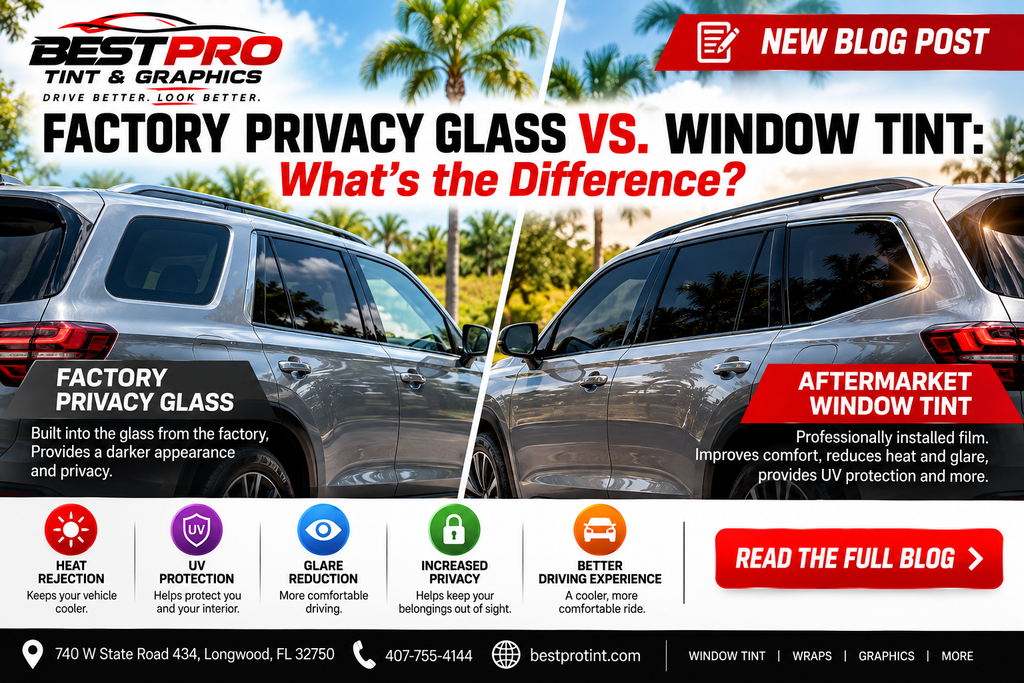
If your vehicle already has dark-looking rear windows, you may wonder why you would need window tint at all. This is one of the most common questions we hear from vehicle owners, especially when they purchase a newer SUV, truck, crossover, or minivan with factory privacy glass.
At first glance, factory privacy glass and aftermarket window tint can look very similar. Both can make the windows appear darker, both can provide additional privacy, and both can change the overall appearance of a vehicle. However, they are not the same thing, and the difference becomes much more important when you start looking at heat rejection, UV protection, glare reduction, appearance, and how the finished vehicle will actually perform in Florida’s intense sunlight.
Understanding the difference can help you make a much better decision about whether your vehicle needs additional window film and, if it does, what type of film makes sense.
What Is Factory Privacy Glass?
Factory privacy glass is glass that is manufactured with a darker appearance, typically by incorporating color or pigmentation into the glass itself during production. It is commonly found on the rear doors, rear quarter windows, and rear windshield of modern SUVs, trucks, crossovers, and other vehicles.
The important thing to understand is that factory privacy glass is part of the glass itself. It is not the same thing as having an aftermarket window film installed over clear glass.
Factory privacy glass is primarily designed to provide privacy and achieve the appearance the vehicle manufacturer wants. It can certainly reduce the amount of visible light entering the vehicle, but the darkness of the glass alone does not tell you how effectively it rejects solar energy.
This is where many vehicle owners become confused.
A window can look very dark without necessarily providing the level of infrared heat rejection that you may expect from a modern ceramic window film.
What Is Aftermarket Window Tint?
Aftermarket window tint is a film professionally applied to the existing automotive glass. Unlike factory privacy glass, the performance characteristics of the film can be selected according to the vehicle owner’s priorities.
Depending on the film, aftermarket tint can provide varying levels of visible-light reduction, UV protection, infrared rejection, glare reduction, privacy, and solar-energy rejection.
This means that window tint is not simply about making the windows darker.
Modern automotive films are engineered products. A high-quality ceramic film, for example, can be selected primarily for heat-control performance while maintaining a relatively light appearance. This is one reason ceramic window tint has become increasingly popular with Florida drivers who want better cabin comfort without necessarily choosing an extremely dark window.
Why Does My Vehicle Already Look Tinted?
This is where factory privacy glass causes the most confusion.
When you look at the rear windows of a new SUV, you may see dark glass and assume that the vehicle already has aftermarket tint. In many cases, it does not. What you’re seeing may simply be the vehicle’s original privacy glass.
The factory glass may already provide a dark appearance, but that does not mean it has the same characteristics as an aftermarket film.
There is also an important distinction between appearance and measured visible light transmission. Two windows can look similar from outside while producing different measurements and different performance characteristics.
That is why professional tint recommendations should be based on the actual vehicle glass and the customer’s goals rather than simply looking at the glass and guessing what percentage it is.
Factory Privacy Glass and Window Tint Can Work Together
One of the biggest misconceptions is that a vehicle with factory privacy glass cannot benefit from aftermarket window film.
In reality, aftermarket film can be installed over factory privacy glass, provided the resulting installation is appropriate for the vehicle and complies with applicable requirements.
This is particularly useful when the owner wants better heat rejection, UV protection, glare reduction, or a different overall appearance.
For example, a customer may have an SUV with dark factory rear glass but relatively clear front windows. Rather than trying to make the entire vehicle dramatically darker, the customer may want the front windows treated to create a more consistent appearance while adding the performance benefits of quality window film.
In another situation, an owner may want to improve the performance of the existing rear glass as well. A ceramic film can potentially be installed over the factory glass to add another layer of solar-control performance.
The final appearance, however, depends on the existing glass plus the film being installed. The film’s advertised percentage should not automatically be assumed to be the final percentage of the finished window.
Does Darker Glass Mean Better Heat Rejection?
Not necessarily.
This is one of the most important things to understand when choosing automotive window tint.
Visible Light Transmission, commonly called VLT, refers to the amount of visible light that passes through the glass. A lower VLT generally means a darker-looking window.
But heat rejection involves much more than visible light.
Solar energy includes different portions of the electromagnetic spectrum, and automotive films can be engineered to control different portions of that energy. Infrared rejection, solar energy rejection, and other performance measurements can therefore be more useful when evaluating how a film will affect cabin comfort.
This is why two films with similar visible darkness can perform differently.
It is also why choosing tint strictly because “it looks dark” can lead to a disappointing result. A customer sitting inside a dark vehicle can still experience substantial heat if the film was not selected for the level of solar performance they actually wanted.
For Florida drivers, this distinction is particularly relevant. The goal isn’t necessarily to make the windows as dark as possible. The goal may be to reduce heat and glare while maintaining a comfortable and practical level of visibility.
What About UV Protection?
UV protection is another area where aftermarket window film can provide an important benefit.
Quality automotive films are designed to block a significant amount of ultraviolet radiation passing through the glass. This can help reduce exposure to UV radiation inside the vehicle and can also help protect interior materials from prolonged sun exposure.
Dashboard surfaces, seats, door panels, carpets, and other interior materials are exposed to sunlight every time the vehicle is parked or driven outdoors.
Over time, that exposure can contribute to fading, discoloration, drying, and deterioration of interior materials.
Factory glass may provide some UV protection depending on the vehicle and glazing, but you should not assume that the appearance of the glass tells you how much UV protection it provides.
A properly selected automotive window film adds another layer of engineered solar protection.
Can You Tint Over Factory Privacy Glass?
Yes, aftermarket window film can be installed over factory privacy glass in many applications.
However, the important question is not simply whether the film can be installed. The more important question is what the finished combination will look like and how it will perform.
If you install a dark film over already-dark factory glass, the final result can be substantially darker than the film’s nominal percentage might suggest.
For example, a customer might see a film advertised as a particular VLT and assume that the finished window will look exactly like that percentage. But if the vehicle already has dark factory glazing, the combination of the glass and film produces the final result.
This is why professional installers should evaluate the vehicle’s existing glass rather than relying exclusively on the film percentage printed on a sample card.
Why Matching the Front Windows to the Rear Can Be Tricky
This is particularly important on modern SUVs and trucks.
A vehicle might leave the factory with relatively dark rear privacy glass while the front door windows are much lighter. The owner naturally wants the front windows to match the rear.
The problem is that “matching” visually is not always as simple as installing the same percentage film on the front windows.
The existing rear glass has its own VLT characteristics. The front glass has its own characteristics. Once aftermarket film is applied, the final result depends on the combination.
A professional installer should therefore consider the existing glass, the desired appearance, the customer’s priorities, and the applicable Florida requirements before recommending a film.
This is also why copying the tint percentage from another vehicle is not necessarily a reliable way to achieve the same appearance.
What About Glare Reduction?
Glare is another reason people choose window tint, and it is often overlooked.
Bright Florida sunlight can create significant glare through automotive glass, particularly during certain times of the day. Glare can make the interior uncomfortable and can make screens and displays more difficult to see.
A properly selected window film can reduce the amount of visible light entering the cabin and can make the driving environment more comfortable.
Again, the objective isn’t necessarily to choose the darkest possible film. The correct film depends on the driver’s priorities, the vehicle, the existing glass, and the desired finished appearance.
Factory Privacy Glass vs. Ceramic Window Tint
Ceramic window film deserves special attention because it demonstrates why appearance and performance should be considered separately.
Ceramic films are manufactured using advanced materials designed to provide solar-control performance without relying exclusively on making the window extremely dark.
A properly selected ceramic film can provide UV protection, glare reduction, and infrared/solar heat-control characteristics while maintaining a clean appearance.
This can be particularly attractive to Florida vehicle owners who spend considerable time driving in direct sunlight.
Someone might want the vehicle to maintain a relatively factory appearance while still improving cabin comfort. In that situation, choosing a ceramic film based on performance rather than simply choosing the darkest available option may make more sense.
Standard, Carbon, or Ceramic IR: What’s the Difference?
Not every customer needs the same type of window film.
Standard films are generally chosen when the primary objectives are appearance, privacy, and basic solar protection while maintaining a lower overall investment.
Carbon films provide another option, combining a darker appearance with additional performance characteristics.
Ceramic and ceramic-IR films are generally positioned toward customers who place greater importance on heat control and advanced solar performance while still wanting a clean appearance.
The right choice depends on the vehicle, the existing glass, the customer’s budget, how much time they spend driving, and how much heat reduction they want.
There isn’t a single film that is automatically appropriate for every vehicle.
What If I Like the Factory Appearance?
That’s completely reasonable.
Not everyone wants an extremely dark vehicle.
Some owners prefer the appearance of a newer vehicle with subtle, factory-style glass. Others want a darker privacy appearance. Some primarily want heat rejection and don’t care about making the vehicle substantially darker.
The advantage of professional window film is that you can approach the installation based on the result you actually want rather than treating tint as a simple “dark versus light” decision.
A good installation should take the vehicle’s existing glass into consideration so that the finished product looks intentional rather than simply adding another layer without considering the overall appearance.
Florida Tint Laws Matter
Appearance isn’t the only consideration when choosing automotive window tint in Florida. The finished installation also needs to comply with Florida’s requirements for sunscreening material.
For the side windows forward of or adjacent to the driver’s seat, Florida law generally requires at least 28% visible light transmittance and limits visible-light reflectance to 25%.
For windows behind the driver, Florida law generally allows film with at least 15% visible light transmittance, while multipurpose passenger vehicles have a specific provision allowing film with at least 6% visible light transmittance when the statutory reflectance requirements are also satisfied.
Florida also restricts material on the windshield, with an exception for a transparent strip along the top that does not encroach into the driver’s direct forward viewing area.
Florida also has specific compliance-labeling requirements for installed sunscreening material. The installer is required to affix the appropriate label to the inside left door jamb, and the statute provides a ±3% tolerance for percentage measurements.
Because tint laws and exemptions can involve specific vehicle classifications and circumstances, vehicle owners should verify the requirements that apply to their particular vehicle before installation.
Don’t Choose Your Tint by Copying Someone Else’s Vehicle
One of the most common mistakes we see is someone pulling up next to a vehicle they like and saying, “I want that exact tint.”
That sounds simple, but it may not produce the same result.
The other vehicle could have different factory glass, different original VLT, a different film, multiple layers of film, or completely different glass characteristics.
Even two vehicles of the same model can sometimes produce different visual results depending on the factory glazing and previous tint installation.
Instead of choosing tint based solely on what another vehicle looks like, it is better to explain what you want: cooler interior, less glare, more privacy, a factory appearance, darker rear glass, better heat rejection, or some combination of those goals.
From there, the appropriate film and VLT can be selected based on the actual vehicle.
So, Do You Need Window Tint If You Already Have Privacy Glass?
In many cases, yes.
Factory privacy glass and aftermarket window tint perform different functions. Factory privacy glass primarily provides the appearance and privacy level selected by the vehicle manufacturer, while aftermarket film can be selected specifically for additional solar-control characteristics, appearance, glare reduction, and other performance objectives.
The question isn’t whether factory privacy glass is “good” or “bad.”
The better question is whether the factory glass is providing the level of performance and appearance you want.
If you are happy with the appearance, privacy, and interior comfort of your factory glass, you may not need additional film on those windows.
If you want better heat control, additional UV protection, reduced glare, a different appearance, or better visual consistency between the front and rear windows, professionally installed window film may be worth considering.
The Bottom Line
Factory privacy glass and aftermarket window tint may look similar from the outside, but they are fundamentally different products.
Factory privacy glass is part of the vehicle’s original glazing. Aftermarket window tint is an engineered film applied to the existing glass. The two can also be used together, meaning a vehicle that already has dark rear privacy glass can still benefit from professionally selected window film.
The most important thing is not simply choosing the darkest film or copying the percentage installed on another vehicle. The right installation considers the existing factory glass, desired appearance, heat-control goals, UV protection, glare reduction, vehicle classification, and Florida’s applicable requirements.
If you’re unsure whether your vehicle needs additional tint, bring it in and have the existing glass evaluated before choosing a film. A proper recommendation starts with the vehicle you actually own—not a generic percentage printed on a tint sample. For another local perspective on ceramic tint, see Why Central Florida Drivers Choose Ceramic Tint and Custom Graphics.
Ready to Upgrade Your Vehicle’s Window Tint?
Best Pro Tint & Graphics provides professional automotive window tinting in Longwood and throughout Central Florida, including Longwood, Lake Mary, Sanford, Altamonte Springs, Winter Springs, and surrounding communities.
Best Pro Tint & Graphics 740 W State Road 434 Longwood, FL 32750 407-755-4144 bestprotint.com
If you’re deciding between standard, carbon, or ceramic window film—or you’re trying to match new tint to existing factory privacy glass—contact Best Pro Tint & Graphics to discuss the options for your specific vehicle.
This article is provided for general educational purposes and is not legal advice. Florida tint requirements can depend on the vehicle, window location, vehicle classification, exemptions, and other circumstances. Verify the current requirements applicable to your vehicle before installation.